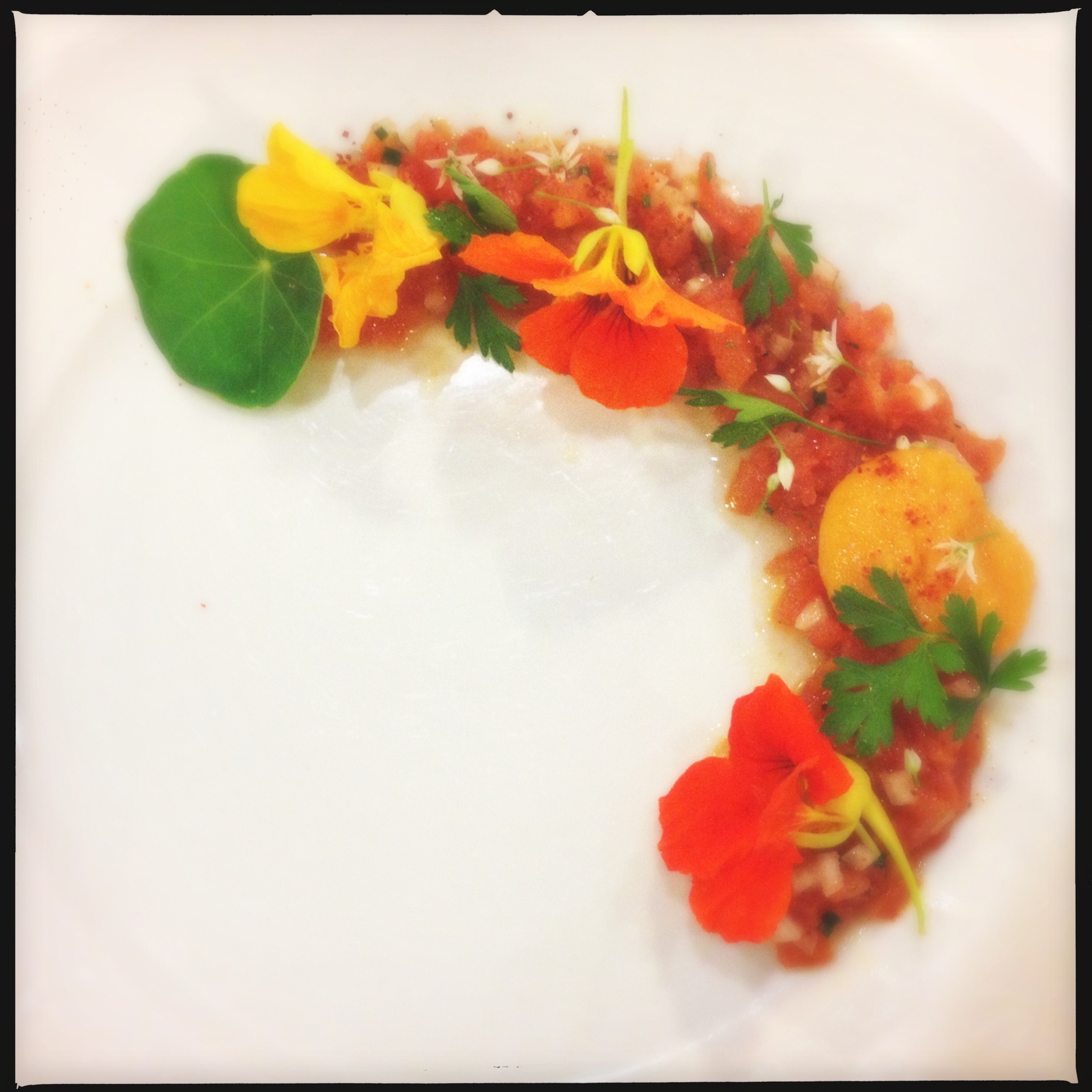
Adaptation.

Despite what many people think, watching shows about cooking, even great shows about famous chefs, isn’t the same as cooking or knowing how to cook. Early this year, up in Philadelphia, my husband and I stood outside the Ritz-Carlton chatting with one of the valets while waiting for our car. He told us about watching the cooking shows – Top Chef, The Great Food Truck Race – and laughed that he used to tell Chef Jennifer Carroll, then-just departed chef de cuisine of 10 Arts and onetime Top Chef competitor, that he felt like almost a pro himself after watching the shows, that it was practically the same. “No, it isn’t,” I replied. “That’s exactly what Jen used to say,” he told me, getting my door.

It’s true. You can’t learn to cook just by watching TV, and even our Ritz-Carlton valet conceded that he mostly had heard of things like shiso but had no idea how they tasted, and knew that risotto is supposed to be runny, not stiff, but couldn’t make it himself. Top Chef is great, but you can’t learn to cook by watching it. If you choose the right show, though, you can actually learn some useful things from TV, like how it looks to dice an onion like a pro, or sear a piece of meat, or make a sugar cage. In case you haven’t had the pleasure, the Great Chefs television series back in the 80s and 90s on PBS featured chefs in their restaurant kitchens, cooking at their stations as though they were talking you through the dish just before service. There was no faux-home kitchen, no excruciating banter, no mugging for the camera, no corny catch-phrases. No BAM, just great technique and superb cooking. They did have some appallingly and catchy theme tunes – “Great chefs, great cities, great food – lovingly prepared by the best” – and the most important chefs in America at the time, both established and up-and-coming. I never missed an episode if I could help it. This was the age of the VCR, and I taped episodes to watch after work, rewinding to watch a chef brunoise a carrot, peel and concasse a tomato, mount butter into a sauce, sear a pork chop before finishing in the oven, and then trying the same from my outdated Minneapolis kitchen.

The enduring lesson of Great Chefs is that fundamentals are essential to good cooking. You can’t adapt a classic dish to personalize it, or make it modern in a way that makes sense, without good technique. Any one of the chefs featured on the series could peel and turn a bushel of turnips in the time it takes most people to dice a five pound bag of potatoes. I don’t golf – never took to it – but in cooking, as in golf, practice pays off. Once you know what you’re doing, you can turn to old favorites and give them your own flair.

Linguine, “guanciale” belly, fried poached egg

I learned about New Orleans by watching Great Chefs long before I ever had the opportunity to visit the city. PBS was a superb tour guide, taking viewers through the kitchens at Commander’s, Brennan’s, La Provence, and the other temples to gastronomy of the day. Years later, in the early 2000s, I traveled regularly to New Orleans on business and dined at the likes of Acme and Herbsaint, Central Grocery and Bayona, banh mí joints in the afternoon, August or Cochon at night. This last September, I took my husband for his first visit, during an engagement to speak at a seminar on food and the law hosted by the Southern Food and Beverage Museum.

On our last night in the city, we dined at my favorite NOLA restaurant, Herbsaint. The same dish drew both his eyes and mine: “Housemade spaghetti with guanciale and fried poached egg.” We surmised this was an adaptation of spaghetti alla carbonara, and although that was clearly its inspiration, the kitchen had taken it a few steps further. The most interesting quality of the dish, to me, was that it tasted a little like sour cream and chive potato chips – in a good way – but it also seemed that the eggs are coated in ordinary breadcrumbs, not, say, potato chip dust. It seemed to me that the pasta sauce might not be the simple egg and cheese mixture of the classic carbonara, but a cream sauce incorporating garlic, which combined with the fried egg for the chive/chip taste.

I generally don’t like to imitate restaurant dishes, but this one was too good to pass up. When we returned home, I cured some pork belly in the manner of guanciale since I didn’t want to wait to order pork jowls. After about a week of curing, I fried the belly into small crisp cubes, made a simple garlic parmesan cream, and poached a few eggs before coating in panko and frying. We don’t have a pasta extruder, essential for producing housemade durum wheat pasta, and frankly homemade dried pasta usually isn’t as good as the kind you buy in the store, so I just used regular bronze die-extruded linguine from Montebello. The resulting dish is creamy, salty, crisp, and savory, reminiscent of the classic carbonara, but adapted to a modern palate.

With the exception of the pork-curing step, you can execute this dish from start to finish in the time it takes to bring the water to a boil and cook the pasta – in other words, about 25 minutes. To be on the safe side, if you are not accustomed to handling poached eggs, I recommend you make a few extra in case you overcook, or the egg falls apart, or you inadvertently break the yolk while breading or removing from the frying oil. All are possibilities. Eat the mistakes on toast or atop grits, with cheese.

1 c heavy cream
12 cloves garlic
1 egg yolk
1 c grated Parmigiano-Reggiano
salt and black pepper

4 oz guanciale or unsmoked bacon

12 oz dried linguine

4 eggs
1/2 c AP flour
1 egg, beaten with 1 tbsp water
1 c panko
chives
black truffle salt

Combine the cream, peeled garlic cloves, and cheese in a saucepot and bring to a simmer. Simmer for about 20 minutes and then transfer to a vitaprep or blender. Blitz until smooth, adding the egg yolk halfway through (if using a lower powered blender, push through a chinois). Set aside.

Garlic-parmesan cream.

Cut the guanciale, bacon, or what have you into batons. Fry in a hot pan until crisp and golden; drain and set aside the crisped batons. [Note: a recipe for guanciale follows]

Pork belly cured in the manner of guanciale.

Poach the eggs in simmering water. Remove carefully with a slotted/perf spoon and slip into an ice water bath. Prepare a clean kitchen towel.

Poaching eggs.

Cooling eggs in ice water bath

Bring a large pot of salted water to a rolling boil and add your pasta. Meanwhile, pour oil about 1″ deep in a small shallow pan, and bring to 350F. Set up a three part breading station. As your pasta cooks, dry the eggs on the clean towel and then bread the eggs (use your hands, not a spoon or tongs as they will be delicate). Fry on both sides. This step only takes a minute or so. Drain on paper towels set over a rack.

Fried poached egg.

Retherm the garlic parmesan cream and drain the pasta. Toss the pasta and reserved guanciale batons in the cream, season with truffle salt, divide among four plates, and top each with minced chive and the fried poached egg.

Pork belly in the style of guanciale

Pork jowl can be hard to find, although a good butcher can get it to you. Rather than go out of your way, try curing pork belly in the manner of guanciale. Although the result will be fattier and less meaty, you can substitute it for guanciale in recipes that call for it, like carbonara, or amatriciana. Not traditional, but close enough.

This is a relatively quick and low-maintenance process that does not involve a subsequent air-drying process.

2 lb pork belly, skin removed
100g kosher salt
50g granulated sugar
5g TCM/pink salt
5g juniper berries
15g black peppercorn
8 cloves garlic, peeled and crushed
6 branches thyme

Crack the juniper and peppercorns coarsely. Combine the dry ingredients. Coat the belly well in the cure.

Dry cure.

Coated in cure.

Place the coated belly in a plastic sealing bag with the crushed garlic and thyme, double bag (to avoid leakage), and refrigerate for about 7-10 days. Turn the bag over once a day to distribute the cure and the expelled liquid.

Remove from the cure and rinse. At this point you may firm up the belly by placing on a rack in a 180F oven for about 2 hours, or simply refrigerate or freeze for immediate use. If refrigerated, use or freeze within a week.

Nuts for potatoes.

I take a lot of guff from friends for not having a sweet tooth. It’s true. I’d rather have a cheese plate than pudding any day, and on my birthday, when my husband takes me out to dinner, he always requests that the restaurant bring me a platter of french fries instead of cake. Evidently people find this strange.

Birthday frites (courtesy Woodberry Kitchen).

Sugar has always been easy to resist. After dinner at a restaurant? Espresso, please. Leftover Halloween candy at work? No, thank you. Cookies on the plane? My seatmate may have my share. This holds true for all sweets, at nearly all times. The exception is doughnuts. As a kid, I ate a lot of doughnuts, since my parents were fond of breakfast pastry, and I’ve always enjoyed the bready puff of a raised doughnut and the lardy-cool cakiness of a golden brown cruller.

A couple of years ago, I traveled to Mobile, Alabama to give a speech, and, after consulting a map, realized that I was a mere two and a half hours from New Orleans. I emailed a friend from southern Mississippi who, thrilled to hear that I would be passing through his hometown of Ocean Springs enroute to Louisiana the next day, immediately responded:

If you’re there tomorrow morning you MUST go to my friend’s donut shop because he makes the BEST hand-made donuts in the world.

…the not-to-be-missed donut shop is the TatoNut Shop in Ocean Springs. Ocean Springs is the cutest town on the Coast (and not just because that’s my home town). A visit to the Walter Anderson art museum is very much worth it. Plus the shops and live oaks on Washington Ave downtown, and the cute harbor (where we always kept our boat), etc.

At 10 the following morning, after leaving the podium, I drove out US-90 to New Orleans via Ocean Springs and stopped for doughnuts. Tato-Nut is a small, square building on Ocean Springs’ main street, tucked between an outdoor equipment shop and the evocatively named Palmetto Place. Its owners, David and Teresa Mohler, produce the finest doughnuts in the world.

As its name suggests, Tato-Nut specializes in potato-based doughnuts. Potato doughnuts aren’t unknown – since the early part of the 20th century, potato doughnut recipes were published as a novel means to use leftover mashed potatoes. Their popularity was so great that, after the Second World War, a chain of potato doughnut shops, called Spudnut, popped up around the country, plying a particularly tender doughnut supposedly inspired by a traditional German yeasted sweet bread. Few Spudnut shops remain, the parent company having been bankrupted in the last days of disco by a fraud scheme involving tax free bonds and the Sacramento River Delta.

Tato-Nut

The hallmark of the potato doughnut is its tender, meltaway bite. This makes sense, as potato flour, being gluten-free, does not provide the elasticity and chew of wheat flour. Some wheat flour is essential or the doughnuts cannot be shaped – in fact, potato doughnuts still are primarily wheat flour – but the addition of potato flour not only reduces the protein-firmness of the doughnut, but somewhat inhibits gluten development.

Potato doughnuts

Nearly all potato doughnut recipes – in fact, all I found – rely on cooked and mashed or riced potatoes; many used too much egg, and many were cake doughnuts leavened with baking powder rather than yeasted ones. I’ve baked cakes before using riced baked potatoes, and although they were tender enough, I wasn’t sure that riced potato was fine enough to maintain the airiness of a great raised doughnut. Indeed, when I met owner David Mohler during my first visit to Tato-Nut, it was clear that he achieves his supremely tender doughnuts using potato flour and not cooked potatoes. Accordingly, I decided to substitute about 25 percent of the AP flour in my typical raised doughnut recipe with potato flour. The resulting dough is very floppy and not necessarily easy to shape, so I recommend cutting into simple and easy to manage shapes like small circles, which fry into balls, or rectangles, which can be filled with jam or cream.

The potato flour I selected was labeled “potato powder” and came from H Mart. Confusingly, H Mart sells another product, labeled “potato starch,” which appears indistinguishable from the powder. Both are snow white and light like cornstarch, but I believe the powder is simply dehydrated and finely ground potato, not the extracted starch. Your best bet will be to consult the organic foods section in your supermarket and look for Bob’s Red Mill potato flour. Do not use dehydrated mashed potatoes.

400g AP flour
150g potato flour
50g granulated sugar (if you like a sweeter doughnut you may use up to 75g)
4g salt
7.5 g instant yeast
1 egg yolk (17g)
75g lard or shortening
275g water (up to 300g depending on humidity)
vegetable oil or lard

Sift together all the dry ingredients in a stand mixer. Combine all the wet ingredients and add to the dry while running the mixer on low. Incorporate until just combined; do not overmix.

Sifted dry ingredients: AP flour, potato flour, yeast, sugar, salt.

Water, lard, egg yolk.

Cover the bowl and set in a slightly warm place. Rise for 60 minutes. Turn out onto a lightly floured surface (50/50 AP and potato flour, or all potato flour), and shape into a large rectangle or circle, turning over once or twice to coat in the flour to prevent sticking. The dough will be very soft and fairly floppy and should only take a few turns and a light rolling with a pin. Cover with a clean cloth and proof for another 60 minutes.

Dough.

Meanwhile, bring a pot of oil about 4″ deep to 365F/185C. When the oil is hot, cut the dough into small shapes just as you are frying (I used a 1.5″ biscuit cutter) and lower into the oil. Do not cut all in advance because the soft dough will spread as it sits and you will lose the leavening when you try to lift it. The doughnuts should almost immediately form airy spheres that float to the surface. Turn constantly using a spider to ensure even cooking. When golden, remove with a spider and drain on a rack lined with paper towels. You can fry the scraps as a cook’s treat; I wouldn’t try to reshape them or they will fall, so expect some irregular shapes.

Roll in granulated or caster sugar, cinnamon sugar (12:1 sugar to cinnamon), or dip in chocolate glaze (recipe below). Cooled doughnuts also may be filled with jelly or pastry cream; use a pastry bag fitted with a small round tip.

Plain sugar, chocolate glazed, and cinnamon.

Feel the lightness.

Chocolate glaze:

1/3 c whole milk
1 tbsp corn syrup
3 oz bittersweet chocolate, chopped
1/2 tsp vanilla paste
2 tbsp butter
1 c confectioner’s sugar

Bring all the ingredients except the chocolate, butter, and sugar to a simmer. Add the chocolate and stir well until satiny. Add the cold butter and bring back to a simmer, stirring constantly. Add the confectioner’s sugar and bring back to a simmer, stirring constantly. When completely dissolved, remove from heat. The mixture should thicken; if it seems too thin, bring it back to a simmer for about 5-10 minutes and cool again.

Life’s a bisque.

Back in the mid-1980s, I waited tables on and off for several years at the Woolworth’s Coffee Shop in the Brookfield Square Mall. In case you ever hoped for a glimpse into my own special brand of psychopathy, here’s one. I loved waiting tables. The tips were awful, owing to a combination of Wisconsin cheapskate-ness and the fact that the food was inexpensive in the first place. I had to work with this guy named Ernie who was studying accounting at UW-Milwaukee and responded to anything I said by telling me “I don’t play penny-ante,” which meant nothing to me at the time and still doesn’t. The busboys and dishwashers were constantly locking me in the walk-in and harassing me by following me around with frozen hot dogs in their pants until I noticed. I had to make all my own desserts, and invariably a family with six kids would demand milkshakes and banana splits during the busiest part of the Saturday lunch rush. But even so, I cultivated a long-term plan to continue waiting tables, possibly even at the Woolworth’s. I’ll finish med school, I’d tell myself, and then when I’m a surgeon or whatever, I’ll cut back on waiting tables to just weekends. You know, just for fun. Sometimes it’s good to let go of your adolescent dreams.

Waiting tables wasn’t simply a matter of taking orders and bringing them to table. In between, we were constantly busy – filling the ice bins, replacing the syrup concentrate in the soda fountains, cleaning everything, making the hated ice cream desserts, dishing out soup. The soup came from the prep kitchen in deep pots, to be inserted into a steam table and ladled out to order. When fresh, the cream soups were pleasantly creamy and studded with bits of broccoli and the like. As they sat steaming for hours, though, they took on the viscous quality of unadulterated Campbell’s condensed cream of mushroom. I liked to favor my customers by telling them when the soup was fresh, and when to avoid it (I know, pretentious). When I learned to cook during law school, I realized why the soup changed so much during its time in the steam table. The Woolworth’s cream soups, like many such soups, are based on a blond roux thickened with stock and milk. As it sits, the flour in the roux continues to gelatinize, and as the liquid in the soup evaporates, the mixture eventually becomes somewhat gloppy. Boiling, or the addition of more liquid, would have thinned it out again, but back then I didn’t understand much about starch properties.

When I make cream soups now, I generally avoid using roux for textural reasons. In addition to the dreaded gloppiness, roux can leave behind a floury taste and sensation. It’s also highly caloric, being equal parts flour and butter. If you crave that sort of thick quality, vegetable soups made with pectin- or cellulose-rich foods, such as carrots and onion, tomatoes and squash, all will be naturally thick when blended, and any added cream is purely for fat and flavor. Seafood soups, like chowders and bisques, are more lighter and enjoyable without the thickness of roux, which obscures the brininess of the shellfish.

Shrimp bisque

The multiple sous vide preps seem like a pain but they make for a seriously intense shrimp fumet, and I really prefer the flavor and texture of the shrimp cooked at the lower temperature. The bisque will not be thick/gloppy like a typical roux-thickened “bisque.”

1 1/2 lbs whole shrimp (heads on would be best but shell is fine), shelled and cleaned
one large onion, about 10 oz, peeled and sliced pole to pole
1 large banana shallot, peeled and sliced pole to pole
1 large or two small stalks celery, peeled and sliced
3 c fish fumet
2 tbsp tomato paste
2 tbsp brandy (I used Torres Jaime I from Spain but cognac also will do nicely)
1/3 c dry white wine
2 fresh bay leaves
several branches thyme
4-6 stems parsley w/leaves
celery salt
piment d’espelette
1 c heavy cream
4 tbsp butter
garniture: pickled ramps, chive, celery leaves, parsley leaves

Season the shrimp lightly with celery salt and seal in a vacuum bag with a sprig of thyme, a bay leaf, and about 2 tbsp butter, divided. Keep cold until about 10 mins before service. [note: you probably won't use all the shrimp for the bisque; feel free to use it for something else like shrimp & grits, etc].

Seal the remaining butter with the celery and onions, and a little celery salt. Seal the shells with the fumet, parsley, the remaining bay leaf and thyme. Set an immersion circulator to 183F; drop in the two bags. Pull the veg after 40 mins and the shells/fumet after 1 hour. Strain the shells/fumet through a chinois lined in a double thickness of cheesecloth; pressing hard on the shells. Turn off the circulator and add some cold water.

[If you don't want to cook SV, place a skillet over medium low heat and, when hot, add the butter. Once melted but not browned, sweat the vegetables in the butter. Do not brown. Set aside. In another pot, combine the shells and fumet; cover and bring to a simmer for about 45 mins. Blend the shells and fumet and pass through a chinois lined in a double thickness of cheesecloth. Restrain if necessary.]

Bring the tomato paste and cognac to a simmer and reduce by 2/3. Add the white wine and reduce by half. Return the sweated vegetables to that pan and add the strained shrimp fumet. Blend using an immersion blender or transfer to a vitaprep. Return to the pan and reduce until you are pleased with the intensity of the shrimp taste (I reduced by about 15%). Add the cream and bring back to a simmer. Season to taste with salt/celery salt, and espelette.

Set the immersion circulator to 140F. Drop the shrimp and cook for about 8-10 mins depending on size; the shrimp need only be cooked through. [If you don't want to cook the shrimp SV you can oil poach instead; try to keep it to around 140F.]

Serve the shrimp and bisque together garnished with pickled ramp (optional), chive, parsley, celery leaf.

Shrimp, pickled ramps, chives.

With shrimp bisque.

That’s a spicy meatball.

Let me begin by saying that I think the whole meatball thing is really played out. Ever since Joey Campanaro started serving his gravy meatball sliders at The Little Owl – and that was in what, 2006? – people have been going crazy for meatballs. Just Google “meatball trend” and you’ll find stories from last year and this one touting meatballs as a “hot food trend,” “vying for most buzzed-about treat with macarons and cake pops.” And that’s about right – five years after it appears in a fine dining context (or in NYC), an idea starts catches fire in popular food culture, where it’s relentlessly beaten to death for a few years until no one can stand the sight of it. It happened with sundried tomatoes and roasted garlic, and it happened with seared tuna. We all know what’s become of cupcakes. Just last fall, I was forced to eat at Macaroni Grill on a work trip and ordered some decidedly mediocre “spicy ricotta meatballs” for lunch. In a year or two, meatballs will be all over every chain restaurant menu in the country and you’ll all be sick of the double entendres about balls.

That doesn’t mean I don’t love a good meatball, though. Along with soups and sauces, meatballs are among the great frugal foods, a way of stretching meat further or using meat trimmings to avoid waste. At their simplest, meatballs are simply ground or chopped meat extended with eggs or a starch like bread or rice; from there, they can assume virtually any guise. In Italy, pork or veal enriched with bread might be simmered in brodo (a meat broth); in Turkey, Lebanon, Iran, and throughout the Middle East, koftes and their relatives combine bulghur or bread with lamb or beef. In Vietnam, pork balls bound with ground roasted rice are grilled and eaten with vermicelli or rice, or simmered in soup. Among my favorite meatballs are albóndigas, seasoned meatballs popular throughout Mexico and other Spanish-speaking countries, usually served in a light broth with vegetables.

Recently, we enjoyed some braised pork tacos prepared by a friend for our regular supper club. Essentially carnitas stewed in a tangy tomatillo sauce, they were tender and meaty with just a little heat from some chiles. Why not enjoy albóndigas featuring these flavors? Simmering porky meatballs in an acidic sauce of roasted tomatillos and chiles tenderizes the meat while conveying some of that meaty savor to the sauce.

Tomatillos, in their husks.

Note: these meatballs won both People’s Choice and Judge’s Choice awards at the Great Grapes wine festival just north of Baltimore yesterday. Prize-winning meatballs! Make them tonight!

SOME PIG

Pork meatballs, tomatillo-chile sauce

This recipe incorporates my suggestions for making the best meatball, whatever your flavors. First, you’ll note, it uses a panade of bread and a liquid (I chose cream for richness but milk or even water are fine). Why panade instead of eggs? Well, if you’ve ever boiled an egg, you know what happens to egg white as it cooks – it becomes solid and tough, even rubbery. The proteins in the meat will become firm enough as you cook them; there’s no need to make the meatballs even harder with egg white. The point is to extend the meat, not to toughen it. If you really need to extend a small quantity of meat and have nothing but eggs, you’re better off making a Scotch egg.

Second, you’ll see that the recipe calls for grinding meat together with onions and garlic. Why? Onion is an excellent filler for meatballs, but there’s nothing worse than a big bite of raw onion inside a cooked piece of meat. By grinding the onion and garlic with the meat, you ensure small bits and even distribution. You also avoid the dreaded pink slime problem. If you don’t have the means or inclination to grind your own meat, don’t worry. Just ask the butcher to grind the cut you select, or, at a minimum, ask whether the ground meat you want to buy is ground in-house. If so, you can feel quite sure you’re not eating some extruded meat slurry from bits scraped up off the slaughterhouse floor, blasted with ammonia. Most supermarket ground beef found in the butcher’s display case is ground in-house; most packaged ground meat is not. Choose knowledgeably.

Don’t be daunted by the list of ingredients – many of them are garnishes and you can take or leave them as you choose. I’ve also provided instructions using ground meat and ground spices. If you use pre-ground products the meatballs can hit the pan in fewer than ten minutes. You can double, triple, or otherwise multiply this recipe as necessary. A pound of meat yields perhaps a dozen golf ball-sized meatballs (after cooking).

For the meatballs:

4 whole allspice, or 1/8 tsp ground
1 tsp cumin seeds, or 1/2 tsp ground
2 tsp coriander seeds, or 1 tsp ground
1 standard slice bread
1/4 c cream, half and half, milk, or water (more fat obviously equals more richness)
1 lb pork shoulder, mostly lean and some fat, or 1 lb ground pork
1/2 medium onion, diced
6 cloves garlic confit or substitute 2 cloves fresh, minced
1 tsp salt, plus a pinch extra
one lime
To garnish:
crema, or sour cream
grated queso asadero or another hard grating cheese
cilantro leaves, washed and spun dry
finely diced onion, rinsed for two minutes in cold water and drained well

For the roasted tomatillo and chile sauce:

1 1/2 lb tomatillos, husked and washed (they’ll be a little sticky; don’t worry if it doesn’t all come off)
2 serrano chiles, more if you like it hot
1 small onion, peeled and diced
4 cloves garlic confit and a little oil from the confit, or substitute 2 cloves fresh garlic, minced, and 1 tbsp vegetable oil
1/2 tsp ground cumin
salt

Start with the tomatillo sauce.

Set the broiler of your oven at the hottest setting. Place the chiles and tomatillos on a sheet pan and set under the broiler.

When the peppers and tomatillos have blistered and are beginning to blacken on top (maybe five minutes, maybe more), remove the pan and flip them over. Return to the broiler and broil until totally softened and blistered. You do want them to be blistered well with a dark brown to black char in parts – this will contribute to the smoky flavor of the tomatillo sauce.

Remove from the broiler, taking care not to spill any accumulated liquid – which may be considerable. Remove the stems from the peppers and discard. Transfer to a blender/vitaprep.

Tomatillos and chiles, roasted.

Place a skillet over medium heat and, when hot, add about 1 tbsp oil from the garlic confit. Add the onions and garlic confit, sweating until translucent. Add the cumin and cook another minute more. Transfer to the blender/vitaprep. Blend until relatively smooth, taste, season with salt, and transfer to a saucepot and set aside. You may wish to add a small amount of water to thin out the sauce.

Prepare the meatballs.

If using whole spices, place the spices in a small, dry skillet over medium heat. Toss from time to time. When you begin to smell a “toasted” spice aroma, remove from the heat and transfer to a spice grinder. Grind well, until no visible chunks of spice remain (this is most difficult to achieve with coriander so if you get a husk or two, that’s fine). If using ground spices, simply combine.

Tear or cut the bread into small pieces (less than an inch) and mix with the heavy cream. Allow to moisten and then mash well with a fork or potato masher. If it is too stiff to mash, add a little water until the consistency of the mash is like a thick batter. (This is called the panade.)

If using a pre-ground pork, mince the onion and the garlic confit as finely as possible. Combine with the ground pork, panade, and about 1 1/4 tsp of the seasonings; mix well with your hands.

If grinding your own, dice the pork about 3/4″.

Combine the salt and about 1 1/4 tsp of the seasonings. Toss the meat, diced onion, and garlic confit with the seasoning and spread it on a sheet pan (lined with a silpat to reduce sticking) in a single layer (use multiple pans if necessary). Cover with plastic wrap and freeze until half-solid. Also freeze the grinding apparatus – the worm, blade, and die.

Grind the entire pork/garlic/onion/spice combination using the small die, into a bowl over a pan or larger bowl of ice to keep it cold. Cook a test piece and taste for seasoning. Add more salt and seasonings if necessary. Combine with the panade and mix well with your hands.

On the grind.

Set the saucepot of tomatillo sauce over low heat and bring to just below a simmer. Place a large skillet over medium high heat. When hot, add a little vegetable oil, just enough to film. Form the meatball mixture into balls a little larger than golf balls and set in the hot, oiled skillet. After a minute or two, roll the meatball – if it sticks, it is not ready to roll. Brown on all sides, rolling from time to time, until all sides are browned. Don’t worry too much whether the meatballs are fully cooked inside as they will continue to cook in the tomatillo sauce. Transfer with a slotted spoon to the tomatillo sauce. Repeat until all the meatballs are cooked.

Cover the pot and cook at just below a simmer, stirring from time to time to ensure that the meatballs all cook evenly, for about 20 minutes.

Pot of meatballs.

Squeeze a little lime juice over the meatballs and serve with crema or sour cream, a little grated queso asadero, raw onion, and cilantro (if you like that sort of thing). Enjoy these with corn tortillas, over grits, or with a simple salad.

Bowl of balls.

I’m ready for my close-up, Mr DeMille.

Civics lesson.

Hey readers! I’ve got a favor to ask. If you read my last entry, you know I prepared risotto for a Marx Foods contest involving riso integrale – unpolished short-grain rice. It’s voting time – won’t you please visit the Marx Foods contest page and vote for my dish? Thanks – and thanks to those of you who’ve already voted! (ps: polls close at 4pm Eastern on Friday, June 1.)

Again: the link to the contest: http://marxfood.com/favorite-risotto-recipe-integrale-gauntlet/

Risotto integrale, savoy cabbage, duck breast.

***Update: I’m through to the second round. Thanks for your support!***

An integral component.

When you hear the words “brown rice,” do you glance anxiously over your shoulder, bracing for the oncoming thud of so many Earth Shoes and the stench of patchouli? You’re not alone. I happen to like brown rice, but the sad fact is that it usually isn’t celebrated for its nutty flavor and firm texture. Instead, it’s most often touted as the more healthful alternative to white rice, appearing as a bland, steaming beige pile beside equally dull crowns of unseasoned broccoli and a broiled salmon fillet. Yawn – and that’s a shame, because brown rice can contribute flavor and texture that polished white rice can’t.

Recently, a Facebook acquaintance asked if I’d be interested in participating in a cooking challenge sponsored by Marx Foods. I contacted Marx Foods and received a kilo of organic riso integrale – unpolished short-grain rice – with instructions to cook through a “gauntlet” of dishes. This is the first, a savory risotto. (The next two, sweet risotto and cook’s choice, depend on gaining enough votes in the first round to advance. So please vote! Follow this link to vote before June 1!)

If you’ve ever wanted to work with brown rice but have been brought up short by the differences from white rice in cooking time and water content, I encourage you to try the integrale when making risotto. Ordinarily, the challenge when making risotto is stopping short of overcooking, at which point the rice becomes heavy and mushy. In addition, the cooked risotto will continue to absorb any residual liquid, changing quickly from a slightly soupy dish to a gummy, starchy lump. Using an unpolished rice still bearing its bran, however, slows the pace at which the rice absorbs liquid. Not only does this make it easier to tell when the rice is approaching the ideal texture – cooked through and not hard, but retaining a firm bite – but the fully cooked risotto will not absorb residual liquid as quickly, maintaining its soupy texture. What’s more, the open-pot cooking of risotto relieves you of any guesswork and worry about under- or overcooking associated with steaming. You simply add as much simmering liquid, bit by bit, as it takes to cook the rice.

The keys to a really flavorful risotto are to toast the rice grains well in oil before adding any liquid (a process called tostatura), to use a really flavorful stock (I happened to have plenty of duck stock at home, but any good stock will work well), and to season with salt while cooking rather than waiting until the end. That way, each grain of rice is seasoned through to its core.

Risotto integrale, savoy, duck breast

To complement the nutty, earthy flavor of the integrale, I added savoy cabbage to the risotto near the end of cooking, and served with a simply seared duck breast, with lots of herbs on the finish to brighten the dish. The resulting dish was faintly reminiscent of that broccoli-cheddar rice we all ate as kids – savoy and broccoli both being brassicas – but in a good way, not a fake out-of-a-box way.

1 large duck breast (magret), about 500g (just over a pound)
1 small yellow onion, peeled and small dice (1/4″)
1 medium leek, white and light green only, washed well and small dice (1/4″)
1/2 medium head savoy cabbage, finely chopped
1 tbsp duck fat or unsalted butter
250g integrale rice (about 1 2/3 c)
250 ml dry white wine (a little more than 1 c)
1.4 l strong duck or chicken stock (about 6 c)
1 dried or 2 fresh bay leaves
4 stalks fresh thyme
chives
4 tbsp unsalted butter, cut into cubes and chilled
about 1/2 c freshly grated Parmigiano-Reggiano
salt and black pepper

About 45 minutes before service, bring the stock to a simmer and maintain at a bare simmer. Cover if necessary to prevent evaporation.

Mise en place.

Place a risotto pan (any deep pan with somewhat rounded sides will do) over medium heat and, when hot, add 1 tbsp duck fat or butter. Add the onion and leeks, season lightly with salt, and sweat until tender. It is not necessary to brown the vegetables.

Leeks and onion.

Add the rice to the pan and sauté until the grains are all coated well with oil and becoming somewhat chalky-looking, about 5 minutes (tostatura).

Tostatura.

Add the wine to the pan and stir continuously until the wine is absorbed. Add some salt – perhaps 1/2 tsp – and the simmering duck stock, a ladle at a time, stirring slowly and well until virtually all the liquid has been absorbed before adding any more. Each addition should take several minutes and the rice should release starch into the stock.

Releasing starch into stock.

After about 30 minutes, while the rice is still firm but nearly tender enough to the bite, add the savoy cabbage and stir well to continue cooking, adding the remaining stock. Taste for salt at this point and season lightly if more is necessary. The rice takes about 30-35 minutes to cook and, when properly cooked should still be firm as opposed to mushy, but must not be hard in the center of each grain.

Adding savoy,

As soon as the rice is cooked, remove from the heat and stir in 4 tbsp cold butter and the Parmigiano. Beat well to coat with the butter; add 1 tbsp water if necessary to loosen. Your goal is to form an emulsion between the residual liquid in the pan and the butter, slightly thickened and stabilized by the starch (mantecatura). Add the Parmigiano-Reggiano. Season with additional salt as necessary and pepper to taste.

Plate the risotto and add the sliced duck (see below). Garnish with herbs. Serves six as primi or as a component with additional vegetables or meat.

Risotto integrale, savoy, duck breast.

Duck breast

This duck breast was cooked at 140F/60C, but the duck may be cooked conventionally on the stovetop and/or finished in a warm oven.

If cooking sous vide: Vacuum pack the duck breast with 2 sprigs of thyme on the meat side. Place in a water bath with an immersion circulator set to 140F/60C for between 45 and 90 minutes, depending on thickness. Remove and dry on paper towels.

Place a skillet over high heat. Score the fatty skin (you should encounter virtually no resistance when attempting to score the fat). Lightly season the duck on both sides. Place fat-side down in the hot pan and allow the fat to render to the desired extent (I do like some of the fat under the crispy skin, but if you prefer to render more, just continue to render the fat). Turn over and sear the meat side for about 15 seconds. Slice.

140F duck breast.

Searing duck breast.

If you prefer to cook conventionally: Place a skillet over high heat. Score the fatty skin. Lightly season the duck on both sides. Place fat-side down in the hot pan and allow the fat to render to the desired extent (I do like some of the fat under the crispy skin, but if you prefer to render more, just continue to render the fat). Turn over and reduce the heat. Cook until just shy of medium rare; remove to a board and rest for about 5 minutes. Slice.

*Thanks to Marx Foods for the integrale!

The Personality Kid.

Fact: admitting to anything less than total adoration of certain foods will result in your ostracism as a “commie.” I learned this lesson the hard way a couple of years ago after publicly declaring that bacon was overused and had become something of a cliché, not to mention a flavor crutch. And I’m probably about to learn it again by saying that, in my experience, pork chops are not always the best the pig has to offer. Next to bacon, perhaps no other part of the pork is as beloved as the chop. Indeed, pork chops and bacon are Homer Simpson’s “two favorite animals.” And in the classic Brady Bunch episode where Peter attempts to reinvent himself as a more exciting character, he Bogarts the name of that evening’s dinner: pork chops … and applesauce.

Before you refer me to the Committee on Un-American Affairs, let me just say that I’ve cooked and eaten some truly delicious pork chops, sure. Brined and smoked, wood-grilled with maple and lemon, or sliced off the bone, fried, and sandwiched within a bun with some slaw, pork chops can be terrific. The problem is that pork chops are unreliable kitchen companions. The blade and sirloin chops contain the most dark meat – usually a guarantee against drying out – but they’re hard to pan-fry because of the bones, never take a good brown crusty sear, and take better to braising. Even after braising, though, the weird bone pattern makes them a pain in the ass to eat. The rib and loin chops have the most manageable bone structure – a curved edge or T-bone, respectively – but the meat is usually very lean thanks to the “other white meat” fetish, and, if too thin, will dry out in the time it takes to get a decent sear.

Enter the ibérico pork chop. Since last fall, I’ve been working with various cuts of ibérico de bellota pork – the rich, sweet cuts of meat from black-footed pata negra pigs that forage acorns in western Spain. Wagshal’s Market provided me a pair of rib chops, which my husband regarded with enthusiasm. Out of one side of his mouth, he gritted the words “pork chops … and applesauce,” jaw firmly locked à la Peter Brady, the Personality Kid. He loves pork chops unconditionally. I knew what I had to do.

Pork chop comparison. Niman Ranch on the left (an admirable chop, but still); Iberico de bellota on the right.

Unsurprisingly, the ibérico pork chop makes up for the shortcomings of the conventional pork chop. It’s got the single bone curving along one side, which leaves you with a nice big eye of meat, and instead of being lean to the point of dryness, it’s got plenty of interior fat to keep things moist and flavorful.

“Pork chops and applesauce”

If you don’t have the ibérico pork chops, don’t worry … you can use a regular pork chop, but try to use one about 1″ thick or so to keep the meat juicy. For these purposes, select a rib chop; the blade chops (cut from near the shoulder), the loin chops (cut to include both loin and tenderloin), and the sirloin chops (cut from near the hipbone) all contain an interior bone or bones that divide the meat. Although I usually do recommend cooking meat on the bone for flavor and moisture, when pan-frying, the meat shrinks slightly, leaving only the bone in contact with the pan. With multiple interior bones, the meat never gets a really good sear. Save those kinds of chops for the broiler.

Cooking the sliced apples sous vide preserves their intense apple flavor. It is not necessary to do so. I have provided instructions for cooking both ways.

2 granny smith apples, peeled and sliced thinly
2 c apple lambic or hard cider
1 c pork stock or white veal stock
3 cloves garlic confit
about 12 oz red cabbage, thinly sliced (about 3/16″)
2 tbsp rendered pork fat or an oil with a high smoke point, like grapeseed
several thyme branches
fresh bay leaf
1/4 dry white wine
2 rib chops, preferably ibérico de bellota

For the applesauce:

If cooking sous vide, seal the apples in a bag with two thyme branches and a pinch of salt. Cook in a circulating water bath set to 183F/84C for 20 minutes. If cooking conventionally, proceed to the next step.

Heat 1 1/2 c of the apple lambic in a small saucepan; bring to a simmer. Reduce by 2/3. Add the stock and garlic confit and reduce again by half. If not cooking sous vide, add the apple slices and two branches of thyme, cover, and simmer until tender.

Remove the herbs. Transfer the reduction and the cooked apples to a vitaprep/blender and process to the desired consistency (for a smooth puree, you may need to add more water or stock).

For the cabbage:

Place a large skillet over medium heat and, when hot, add about 1 tbsp of the pork fat or oil. Add the cabbage, bay leaf, and a couple of sprigs of thyme and sauté until just wilted. Add the white wine and toss; the cabbage should turn a bright magenta due to the wine’s acidity. Once the wine has evaporated, add 1/2 c apple lambic; reduce heat and continue to cook until completely tender. Season with salt.

For the pork chops:

Season well with salt on both sides. Place a skillet over high heat and, when hot, add 1 tbsp pork fat or oil. Add the pork chops, searing on the fat edge first to render, and then on one side. Add the thyme branches to the rendered fat and baste. Turn over when golden on the bottom; reduce heat to medium low and continue to cook, basting with the thyme oil, until about medium on the inside. Rest for five minutes before service.

Serve with the apple sauce and red cabbage; garnish with additional thyme and chives if you have them.

Pork chops, lambic-braised red cabbage, chunky applesauce.

*Thanks again to Wagshal’s Market and Iberico USA for the pork chops featured in this dish.

Follow

Get every new post delivered to your Inbox.

Join 217 other followers

%d bloggers like this: